
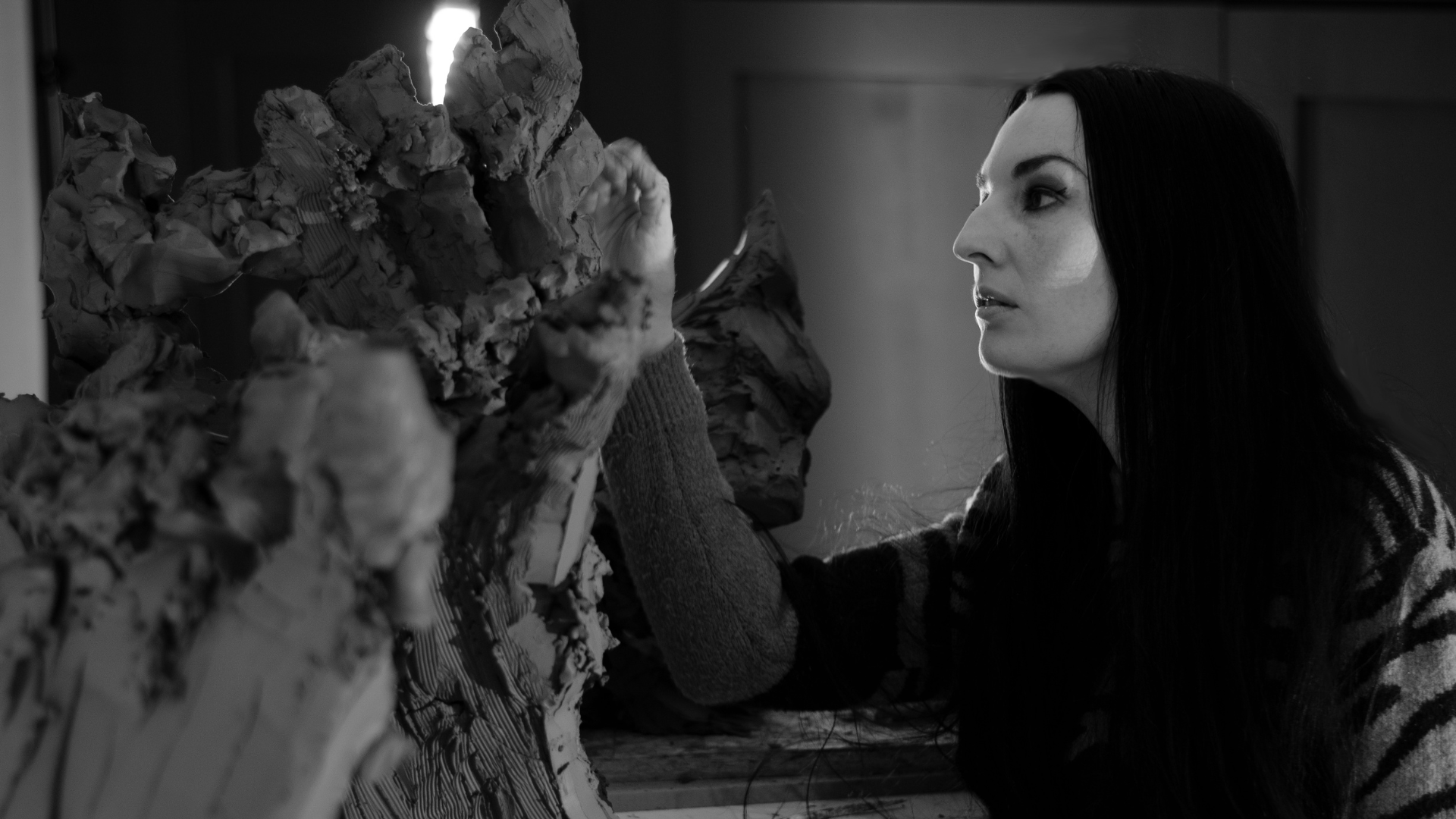
Aideen Barry sees the world a little differently than your average person. Every building has a rich history tucked away discreetly by the passage of time, rarely given a second thought or closer look by passersby. Aideen has a keen eye for the hidden histories associated with architecture, and has honed her focus on one very special place: Kaunas, Lithuania. Elysia from our Box Office & Marketing Team sat down with Aideen to discuss her non-verbal film Klostės/Pleats/Folds, which centers around the history of the city of Kaunas through the rise and fall of its buildings using the metaphor of pleats, or folds, in time. Klost
3 words to describe your art?
Democratising, uncanny, intersectional.
Tell me about the film Klostės/Pleats/Folds.
Klostės means pleats, or folds. This film is mostly stop-motion animation, and when there’s all of this invisible labour that goes in behind it, it’s like a fold; you see only the first surface, but behind the fold is all of the effort that went into making the magic. It’s an architectural term that you see a lot in architectural heritage as well, which I was inspired by. This Lithuanian architectural movement happened between 1919 – 1939, called Interwar Modernism, which in the West we call Art Déco, and it grew out of this particular time after World War One where Lithuania got its independence. They had to build a European capital in the space of eleven years and Kaunas is a lot like Cork in the sense of being the “real capital” because Lithuania didn’t get the city of Vilnius back after the Romanoff Dynasty fell, so they essentially had to build a new city overnight.
They sent all their architects to study under Corbusier and they came back to build this beautiful European capital called Kaunas, which I visited in 2018. I couldn’t believe how beautiful it was, or that it had survived World War Two, but then I heard the story that most of the architects and artisans were Jewish, and in 1939 together with the Lithuanians, the city rounded them up and murdered them in the Holocaust. Citizens were moved from all over the USSR out of their cities, like in Uzbekistan and Georgia, and ended up in Kaunas. Four years later the Russians occupied the city, and they did so for the entire duration of the USSR. Buildings that were built for families of one were now holding fifty, and when they finally got that independence back in 1991, they started to see the buildings in Kaunas as an association with trauma, just like we did in Ireland; we got rid of our colonisers but we still saw this Georgian architecture of occupation as a thing of trauma, so they started pulling them down. A very proactive group of architectural historians and architects tried to save the city by getting UNESCO World Heritage status for the city, and they approached me with a budget of €150,000 for the European Capital of Culture, which was Kaunas in 2022. I have a long track record working with European Capital of Culture, I was commissioned quite early in my career when Cork was chosen for it. So they invited me to come along and they were really interested in how I worked with non-art communities to co-create film and artworks. They said they wanted my help to save their architecture from oblivion. I said at first, “I’m Irish so I can’t tell your story, but I can work with your citizens to write the story”, and so this film is made in collaboration with over a thousand Lithuanian citizens.
It’s designed like Italo Calvino’s Invisible Cities, and this amazing writer called Sandra Bernotaitė who is from Kaunas helped me find fifty amateur short story writers who I asked to tell me the story of the what the buildings saw, and from that we created the story of a city, within a city, within a city. It’s a series of short films all sewn together like a blanket’s pleats, or folds of fabric. I started shooting it during the pandemic and unfortunately I had to leave Lithuania during the COVID pandemic, so I had to try teach people stop-motion over Zoom. I initially only wanted 50 volunteers but there were thousands upon thousands of people who had come to the end of their Netflix accounts and were so bored stuck at home, so we ended up with thousands of people volunteering to be part of the film.
Is there another city you’d like to take on a project like this for?
Oh, Cork. When you think of it, the city was burned to the ground at one point, and the classes move around quite fluidly in this city. Your working class and upper class mix, and there is some remarkable creativity that comes from that. I’d love to do a project around Cork heritage, how the first ever rollercoaster was in the River Lee up by the shaky bridge, how we got our plazas and places like the Peace Park (Bishop Lucey Park). We are one of the fastest growing cities in Europe now and it’s going to change so much with the docklands redevelopment too. It would be wonderful to do something with that post-industrial landscape before that heritage is lost.
You make use of visual effects, stop-motion and props in your work, so how do you feel about AI specifically in filmmaking?
I’m allergic to AI use in filmmaking. It’s a very dangerous material that’s been unleashed without any prohibitions or policies around its use. I am particularly nervous around the likeness and faces of actors being used, unregulated use without consultation of unions or anyone involved in the film industry. Now it is of course a tool, but a tool is only as good as how it’s applied. At the moment it’s mainly just making junk from what I can see. I really like the hand-made; I use a lot of things that were used in early filmmaking, like for instance there was an artist named Eugen Schüfftan who invented the Schüfftan process to make early green screen technology. He was an architect who left architecture to go into the arts and famously worked on Fritz Lang’s Metropolis. It was use of mirrors and illusion to create effects and changes of scenery in a way that AI can’t replicate. People really appreciate the commitment artists make to the hand-made rather than the seduction of AI that wears off very thin, I think.
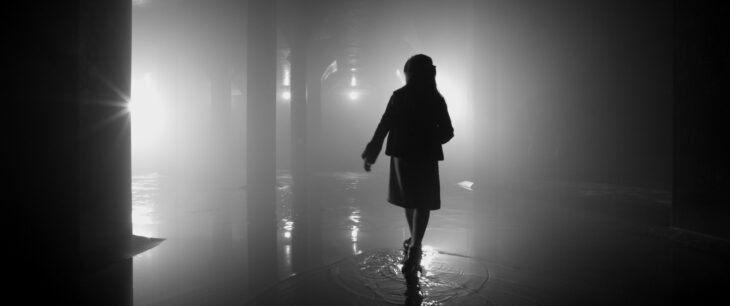
Why did you choose to make the film black and white?
Timelessness. There was so many things happening, like a bending of time. There’s lots of reference to the 2019/2020 COVID pandemic time in Klostės, and to the 1919 pandemic with the Spanish Flu too. We were looking at the same strategies of filmmaking during this process that happened at that time too, so there’s lots of reference to the COVID pandemic in Klostės. Yet, I wanted to give that timelessness to some of the protagonists the short story writers wrote about, where they were like ghosts trapped in the walls. They could be any one of us. Kaunas was a multicultural city at that time and had jazz bands coming over from New Orleans, so there were people of colour, there was a trans and non binary community in the 1920’s there too, and all of that was effectively erased by fascism. We are seeing the exact same mirroring happening now, so the idea of filming in black and white was a way of folding time, to give you the cognitive dissonance of, “oh, we’re having these conversations again?”, and why is it necessary to nip right-wing rhetoric in the bud? It’s also a way of saying it isn’t always is black and white, there are all these greys and subtleties within what is made up of black and white and binary positions.
You have exhibited artwork internationally. Is there a particular place that still stands out for you as a special experience?
Two things: I would obviously say Klostės in particular because it helped secure the city their UNESCO World Heritage status and that really was a highlight for me. When art can affect social change like that, that’s actually kind of astounding. Another project I’ve been working on called Oblivion / Seachmalltacht / ᖃᐅᔨᒪᔭᐅᔪᓐᓃᖅᑐᑦ , which is a collaboration with banned and outlawed music which is still traveling around the world at the moment. It’s just been shown in Denver, Colorado in a country where ideas and music are getting banned again. That project has been really important to me. Outlawed knowledge or banned ideas are really important to me. I’m also going to be having a huge show in Toronto, Canada in October, and Peter Gabriel will be taking it on tour as part of his new album project as well. When I was working on it I thought that it was on really shaky ground because I’m a white woman of privilege. We can recognise a lot of our post-colonial trauma and the idea of self-determination as Irish people, but I was thinking, how would I work with an Inuit throat musician where I’m giving RIIT ᕇᑦ (Aideen’s collab partner for the project) the same advantages or elevating their status through my own privilege? Those things are always present in me. You can see it now in Palestine; the most dangerous people are artists, because they make up working classes. Those two projects are two I’m the most proud of if I die.
Who knows though, at the moment I’m working on so many other things, like an opera art film inspired by Dr. James Barry, a very famous Corkonian. I’m shooting it in South Africa where he was based. What happened was, while working in Kaunas they had selected four commissioned artists; Marina Abramovic, William Kentridge, myself, and Yoko Ono. They told me William in particular was coming along to my film and he loved my work, which he had exhibited before in Johannesburg at his foundation. He came along with this wonderful composer named Philip Miller, and we went for dinner. William asked if I wanted to go to South Africa for us to work together so I asked him had he ever heard the story of Dr. James Barry. The story was, he was the highest ranking decorated medical officer in the British Armed Forces who opened non-segregated medical schools in Montreal and Johannesburg in the 1820s. He was named Dr. James Miranda Barry after the revolutionary Francisco de Miranda who paid for him to go to medical school. His uncle, James Barry Sr., was the first Irish Catholic man to be president of the Royal Society of Arts. He performed the first ever successful caesarean section in South Africa, in which both mother and baby survived. He had this wish that when he died he wanted to be buried in the clothes he was wearing whenever he passed, but they ignored these instructions. They discovered that James had been born either intersex or female, and the British were so horrified by this that they sealed the record and expunged his contributions to medical science. When I said this story to William and Philip, their jaws were on the floor. So they said, why not come to South Africa? I went to South Africa and Cape Town two years ago then, to start that project.
Cats or dogs?
It has to be dogs. I love both but I own two Bernese mountain dogs right now. I work with Bernese Mountain Dogs Ireland to rehome and foster big dogs, and they are the most special of dogs. I have neurodiverse children and these dogs are amazing at leaning in and having this symbiotic relationship with you. I love cats too though!