
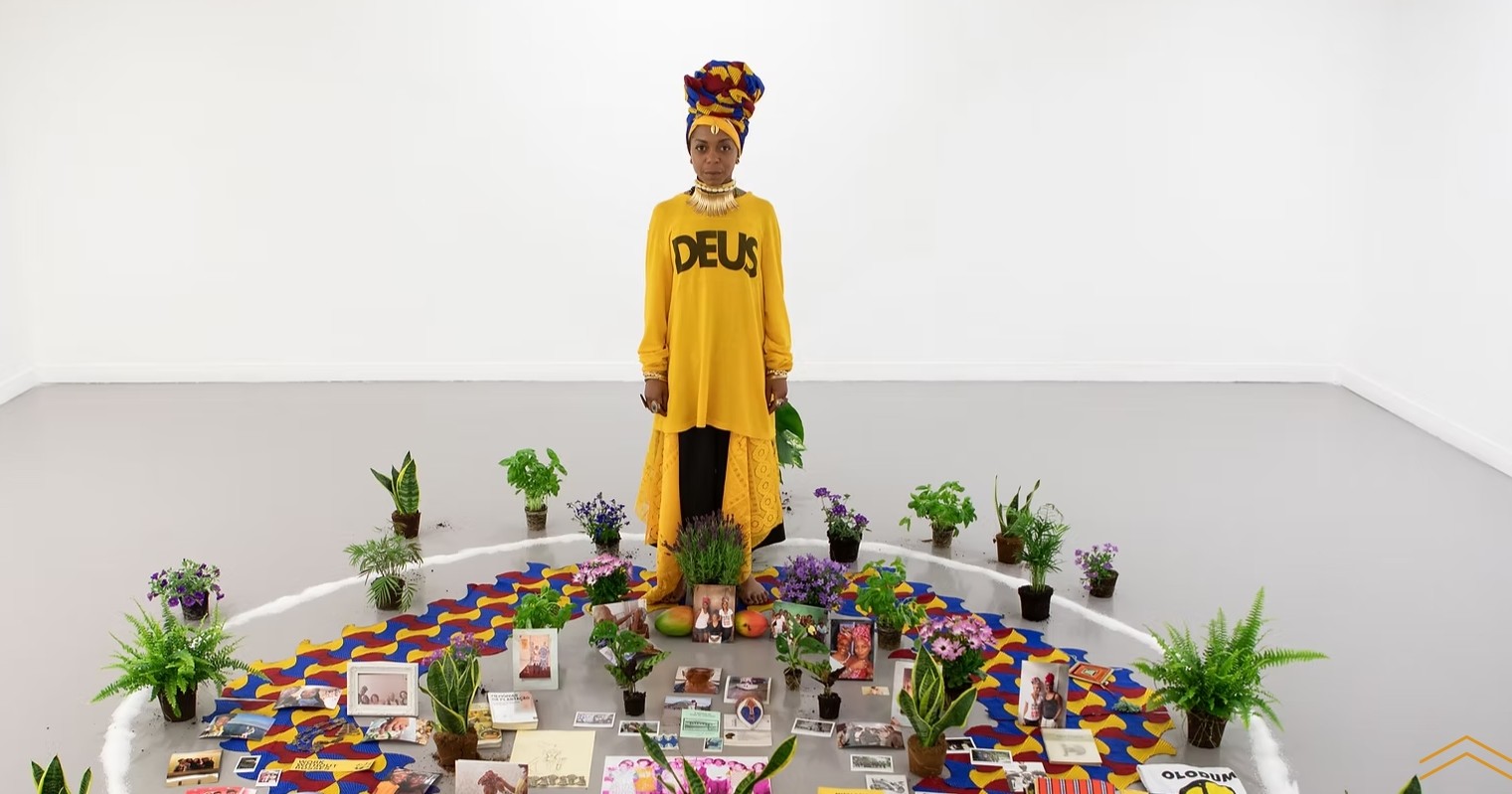
Thaís Munis is the artist selected by Crawford Art Gallery to participate in this year’s Artists Film International 2026 (AFI). Her short film The Kite Ballet will form part of the looped screenings in Triskel Christchurch from Tuesday 25 – Thursday 27 August.
Join Thaís, Dr Eve Olney and Dawn Williams, curator, Crawford Art Gallery, for a free public talk on Thursday 27 August at 1pm.
Ahead of featuring her film, we got to know Thaís a bit more:
● 3 words to describe your art
Experimental, decolonial, relational.
● This year’s AFI theme is “A Kind of Power”. What does that mean to you?
“A Kind of Power” suggests a shift away from traditional, top-down definitions of strength toward a more decentralized and generous way of existing. Rather than viewing power as something singular or controlling, I see it as an acknowledgment of diversity. Every artist, film, and individual holds a unique form of power. This theme highlights how those varied strengths coexist, enrich one another, and reshape how we share space in the world.
● Tell me about The Kite Ballet – where did the idea come from, and what did you learn from creating the short film?
The Kite Ballet was really a gift of chance. I had asked artist and activist Clara Domingas, who is local to the Itapuã neighbourhood, to help me find a location for a performance. As we walked through the dunes, Clara guided me to a spot where an incredible scene unfolds every Sunday afternoon: adults coming together to play and fly kites across the Abaeté dunes. I was already researching joy and mental health, and seeing that scene felt like watching those ideas come to life. It was a beautiful reminder of what a non-extractive relationship with nature actually looks like. The biggest lesson I learned from making the film is that the journey matters so much more than the original destination. Trying to plan one performance actually opened up three distinct bodies of work: the film itself, the performance Aweto Abaete, and the series Take Me To The Land I Also Belong To, which I’m presenting at the 39th Panorama of Brazilian Art at the Museum of Modern Art in São Paulo. Beyond the theoretical side, it also taught me the actual craft of making kites, showing me just how deep and complex simple things can be.
● What message or lesson do you hope viewers will take from The Kite Ballet?
At its heart, The Kite Ballet is an invitation to reconnect. I want to show how community builds and holds the living memory of territories, serving as an antidote to modern ideas of “development” that often disconnect us from our environment. Through the film, I explore body-landscapes, treating the body as a continuous extension of geography, alongside principles of degrowth that prioritise harmony over extraction. Ultimately, I hope viewers leave not only reflecting on these ideas, but also feeling an immediate, joyful urge to return to simplicity: to play, look up, and fly a kite.
● A lot of your work centres around themes of community and identity. What are some of the challenges you face in getting people to question their ideas of representation and belief?
One challenge is that representation and belief are often treated as fixed or familiar. Both participants in the work and audiences may approach them through inherited assumptions rather than curiosity. My role is to create spaces for collective learning, where everyone involved in the process can become visible and where curiosity can emerge. I am interested in creating encounters that allow people to question what they think they already know, rather than simply receiving a fixed interpretation. There is also the challenge of translating experiences that are embodied, communal, and often carried through oral histories, ritual, gesture, and material practice into a shared exhibition or public space. I try to do this without simplifying or reducing those experiences to something that can be easily consumed, but require an extra layer of attention.
● Your work has been exhibited internationally. Is there any particular exhibition you’re most fond of, and why?
My first solo exhibition at the Sirius Arts Centre in Cobh, Co. Cork, in 2024 was truly foundational for me. Creating a conversation between all those pieces to fill that gorgeous space was such a meaningful process. Handling the layout, the framing, and the whole expography for the first time was a major leap forward as an artist. Plus, a key work from that exhibition actually led to my debut at the Irish Museum of Modern Art, which created this beautiful chain of connections. At the same time, looking ahead to the 39th Panorama of Brazilian Art at the Museum of Modern Art of São Paulo brings a really emotional feeling. MAM is a landmark institution, and this show actually reopens the museum after two years of renovation. Located in Ibirapuera Park, where raw architecture and natural surroundings exist side by side, it’s an incredible setting. Being invited into a programme with roots back to 1969 really honors my connection to my birthland, marking a huge moment of sharing where my work stands right now.
● How did you first delve in to the arts? What was your first chosen artistic medium?
I first entered the art world through textiles and fashion. I’ve always been drawn to fabrics: their prints, textures, and limitless capacity to communicate. After my first year studying fashion, I felt disconnected from the fast pace of the commercial industry. I shifted toward treating textiles as a conceptual artistic medium rather than a functional product. Textiles quickly became my primary material, first through headwraps conceptualised as wearable sculptures, and later by exploring their inherent cultural and symbolic codes. My practice expanded into performance as a relational art
form, using textiles and memory as a Trojan horse to open up conversations around social justice while building meaningful dialogues with people.
● Explain a bit about The New Atlantic Triangulations, your ongoing research project.
The New Atlantic Triangulations is an ongoing territory of research and artistic exploration. It explores ideas of joy, mental health, and non-extractive relationships with nature, anchored in the triangulation I carry through my own body: as a Brazilian woman of Central and West African heritage who has also become an Irish citizen. The project asks what traditional knowledge systems across these territories can teach us about emotional well-being, the “health of the head,” and collective joy amidst modern mental burdens. Ultimately, it functions as an experimental space to ask: how can I use art as a transmitter of comfort while keeping critical thinking at its absolute core?
● What’s next for you following AFI26?
Following AFI, I’m really excited to go to São Paulo for the 39th Panorama of Brazilian Art at MAM. Right after the opening, I head straight to Paris for a three-month residency at the Centre Culturel Irlandais, which was awarded to me for this film through the RDS Visual Arts Awards. Having just spent a full month on a research residency in Angola, I can’t wait to dive into making new work in Paris and engage with another vibrant European art scene. Once I return, I’ll be moving into my new studio at Temple Bar Gallery + Studios, which I’m so ready for after spending time without a dedicated space to work..
● Cats or dogs?
Cats