
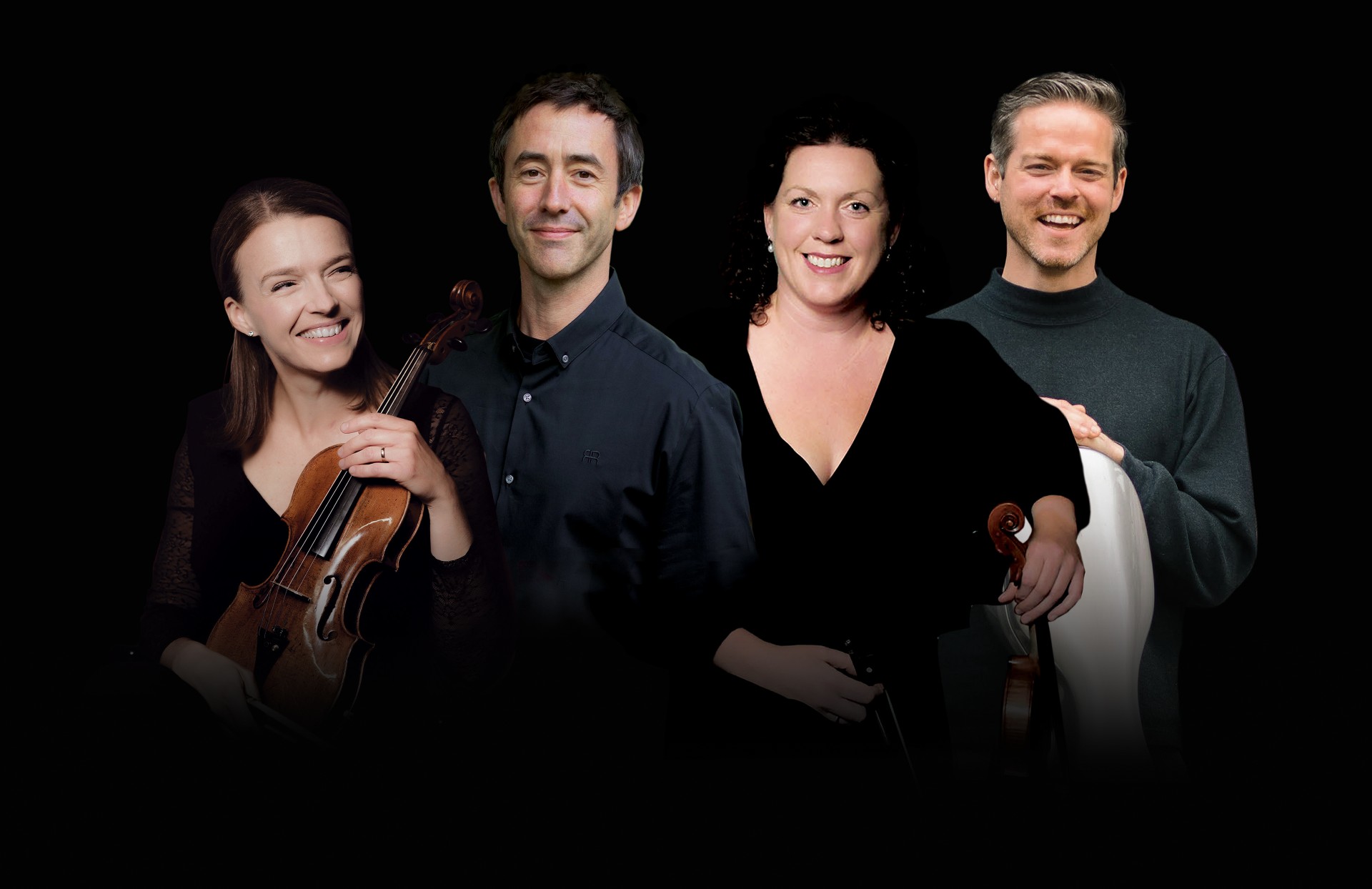
Banbha Quartet’s performance on Sat 7 March will mark International Women’s Day in association with Finding A Voice here at Triskel Arts Centre. In anticipation of this stunning programme of fine music by women composers of the past three centuries, Elysia from our Box Office & Marketing Team sat down with Maria Ryan, Banbha’s violinist, to find out more about this unique quartet’s origins, their future plans, and why they wanted to highlight International Women’s Day (March 8).
Describe your music as a quartet in three words.
Exciting, energetic, and enthusiastic.
You have chosen four distinct female composers for your programme in honour of International Women’s Day; why did you choose Jane O’Leary, Dobrinka Tabakova, Henriëtte Bosmans, and Emilie Mayer to be your composers?
Jane O’Leary is celebrating her eightieth year in 2026, and we have played some of her music before. So, it was quite important to us that she was represented because it’s such a big year for her. We’ve also met her before and gone through some of her music with her, so that was really a no-brainer for us. The others (Tabakova, Bosmans, and Mayer) are less well-known, and from periods where we already know all of the male composers. Often when we think of female composers we think of contemporary female composers because that’s much more on the forefront now, but we forget about the ones that came before and paved the way, just not while in the spotlight the way their male counterparts were and are. We have Mayer, whose work is very Beethoven or Brahms, very romantic but also accessible to people with beautiful melodies in it. The Tabakova is just really cool, it’s full of funky rhythm and it’s contemporary but it’s also a bit jazzy with different influences. We wanted something that was female composers, but similar to what you’d programme for a “traditional” concert with all of those elements.
What was it like to meet Jane O’Leary having performed her work before?
We met her here in Triskel, she came to a sound check rehearsal a few years ago! We had emailed before but never met, and it was really nice for her to actually see what we were doing and to receive her input. She uses a lot of techniques that you need to see in person, it wouldn’t make sense on paper or sound how she intended, so that was lovely too, to have her input for that.
Banbha was formed in 2020– how did your quartet form?
I had recently moved back to Ireland from living abroad, and Aoife Burke was our original cellist. She first contacted each of us asking if we’d like to form a quartet, because Chris (Marwood, NSQF Founder) was first putting together this line of shows, so it’s because of them Banbha exists. We came together to see what happened and now here we are.
This is the quartet’s sixth tour for NSQF. What have you found has changed most in those six years for performing musicians?
The NSQF is an unbelievable foundation to have in Ireland. There are so many quartets now that have the opportunity to perform all around the country, and the beauty of a quartet is you can perform truly anywhere because you don’t need to bring specific things like a piano, you can just rock up with some music stands and play. I think for musicians, we get the opportunity now to perform around the country and it’s really exciting to bring that to rural communities who might not have access to much live music. Last year we went to Donegal for the first time and played a piece we commissioned by Sean Doherty and that was a great way to meet new audiences. There’s much more emphasis now, or more thought about making music more accessible that there wasn’t before. Playing everywhere is really important, and that’s something NSQF does really well and other organisations should continue making similar steps.
What venue have you performed in that was special to you? What’s your dream venue for Banbha to perform in, if you could play any venue on earth?
A really special concert we did was one of our very first, in Manor Hamilton. It was the first live concert and it was during COVID. There was a single week in October 2020 where tours were allowed to happen and ours just happened to fall within that week, which was just incredible. No one had played for people since March of that year and it felt like an awfully long time. We’ve played all over the place though; last year Lidia (Jewloszewicz-Clarke, violin) and myself played in Carnegie Hall as part of Camerata Ireland. I’ve also played with Robin (Panter, viola) as part of the Irish Chamber Orchestra over in Limerick’s concert hall just after COVID restrictions lifted. The orchestra was in tears, the audience were in tears, it was just such an emotional time performing again after COVID. Some concert halls have amazing emotions with them, but COVID brought into perspective that it doesn’t necessarily matter where you are, the most special concerts don’t always happen in the most famous concert halls. Sometimes it does feel a little stupid to not make a bigger deal of it, but those bigger venues can sometimes be more stressful, so I find once you’ve done that, it’s not so important anymore where you play. All of us in the quartet have played in Wigmore and Carnegie, ticked the boxes of amazing venues around the world. What we’re looking for now is a real connection with the audience, to bring the excitement of classical music to our audiences.
What plans do you have for 2026 as a quartet?
We are a tour in March this year, but we’re branching out more into education projects which will be a big focus in 2026. We’re working with Classical Kids in Dublin and hope to see it expanded. We want to enthuse people younger or older about classical music, it’s really sad to us when people say classical music isn’t exciting or they think they need to know loads about it to enjoy it. We want to make it so accessible you don’t need to know anything about it to enjoy it. We have also tried adapting our performance for younger audiences, and I found the older crowds in their fifties also actually enjoyed that we broke the movements of the piece up by chatting on stage, explaining the music we were performing. They’d heard all the terms before but didn’t know what they meant, and we took time to explain them to our audience.
Cats or dogs?
I have both a cat and a dog! Lidia has a dog, I’m not sure what the others have so I’m going to assume the quartet is divided on that one.
Tickets are available now for all four Spring String Quartet Series 2026 concerts, brought to you by NSQF.